For English see below.
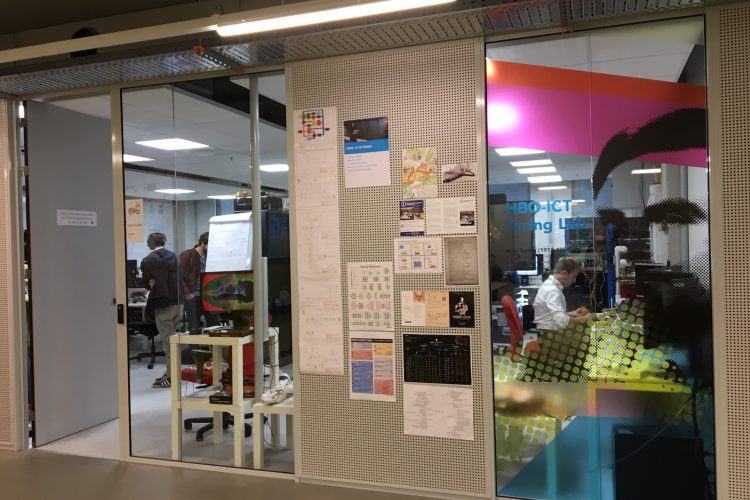
Ruimtes met daarvoor ingerichte werkcomputers, 3D-printers, robotarmen, servers, kabels en allerlei technische projecten. Het zijn de labs van HBO-ICT op de vierde verdieping van Heidelberglaan 15. Je herkent ze aan de opvallende namen van computerwetenschappers die kleurrijk op de transparante wanden pronken. De labs trekken veel bekijks, zowel van binnen als buiten de opleiding.
Onderwijsassistent Tim le Febre en docent ICT Brian van der Bijl zijn blij met de nieuwe labs. “We zijn erg vooruitgegaan op zichtbaarheid. Op onze vorige locatie aan de Daltonlaan was er minder interactie, omdat je van buiten niet kon zien wat er in de labs gebeurde. Nu zijn veel meer mensen nieuwsgierig naar wat er gebeurt, ook studenten van andere opleidingen”, vertelt Le Febre.
Van theorie naar praktijk in Dijkstra en Torvalds lab
Le Febre beheert het Dijkstra en Torvalds lab met bijbehorende serverruimte die gebruikt worden door de afstudeerrichting System and Network Engineering (SNE). “We beschikken over professionele apparatuur, het 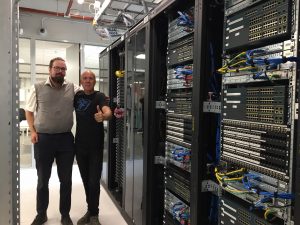 ziet eruit zoals in het bedrijfsleven. Studenten brengen hier de theorie in praktijk. En die praktijk is meestal verre van ideaal. Zo kunnen ze te maken krijgen met storingen die ze moeten leren oplossen. Studenten leren op die manier waar ze het over hebben en dat is belangrijk voor als ze in de toekomst in het bedrijf projecten gaan leiden.”
Op Heidelberglaan 15 kunnen de labs beter worden ingezet door middel van zogenaamde infrastructuur patches. Le Febre: “Op de Daltonlaan hebben we daar al een pilot mee gedaan. Ik kan nu vier verschillende ruimtes koppelen aan de serverruimte en daardoor hebben studenten meer werkruimtes om hun opdrachten uit te voeren. Ze kunnen bijvoorbeeld in het Lovelace of Hopper lab gaan werken terwijl de serverruimte aan de overkant zit.”
Turing lab populair als creatieve werkplaats
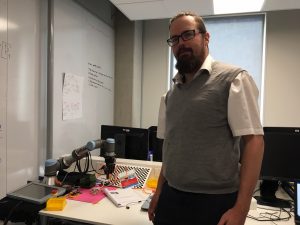 Even verderop, grenzend aan het instituutsplein van ICT, bevindt zich het Turing lab. Dit lab wordt beheerd door docent Brian van der Bijl. “Het is een creatieve werkplaats en een echt ontwikkel lab. We stimuleren studenten om iets van hun eigen ideeën te maken. Hier ontmoeten eerstejaars studenten ouderejaars en zij helpen elkaar bij projecten.” Volgens Van der Bijl komen de doelen van het Turing lab veel beter tot hun recht op de nieuwe locatie. “Het gaat om inspiratie, verbinding en community. Doordat vanaf het instituutsplein is te zien wat er gebeurt, trekt het lab de aandacht en komen meer studenten maar ook medewerkers in het lab werken. Het is er gezelliger en toegankelijker dan de medewerkersruimte. Ook zorgt het lab voor meer dialoog tussen verschillende richtingen van de opleiding ICT.” Van der Bijl hoort nu al van studenten dat ze zouden willen dat het Turing lab groter was. “Dat zie ik vooral als iets positiefs dat er
 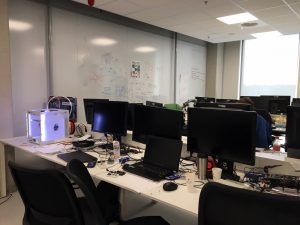 meer mensen willen zijn dan er kunnen zijn.”
In de labs staan veel technische projecten die bij open dagen studiekiezers over de streep trekken. Le Febre: “Als ze zien hoe ICT er in de praktijk uitziet, spreekt dat meer aan dan een lokaal met alleen bureaus en werkcomputers. En nu de labs zoveel zichtbaarder zijn, is dat alleen maar goed voor de toestroom van nieuwe studenten.”
Visible labs bring IT to life
Rooms with dedicated workstations, 3D printers, robot arms, servers, cables, and all kinds of technology projects. These are the labs for the Information and Communication Technology (ICT) degree programme on the fourth floor at Heidelberglaan 15. You can recognise these labs by the eye-catching names of computer scientists that colourfully adorn the transparent walls. The labs have been attracting a great deal of attention, both from ICT students and from across the university.
Teaching assistant Tim le Febre and ICT lecturer Brian van der Bijl are happy with the new labs. “We have improved a lot in terms of visibility. At our previous location on Daltonlaan, there was less interaction, because you couldn’t see from the outside what was going on in the labs. Now, a lot more people are curious to see what is going on inside these labs, including students from other programmes,” says Le Febre.
From theory to practice in the Dijkstra and Torvalds labs
Le Febre runs the Dijkstra lab and the Torvalds lab with the associated server room, which are used by students doing the System and Network Engineering (SNE) major. “We have professional equipment, the same as you would find in the real-life business world. This is where students put theory into practice. And the real-life situations we recreate are often far from ideal. Students may, for example, come up against failures and outages they have to learn to resolve. This is how students learn what the theory is really all about, and that’s important for when they actually start running projects at companies.”
Heidelberglaan 15 enables better use of the labs thanks to so-called infrastructure patches. Le Febre: “We already ran a pilot with this back at the Daltonlaan site. I can now link four different rooms to the server room, giving students more work areas where they can work on their assignments. They can, for example, work in the Lovelace lab or the Hopper lab with the server room just across the hall.”
Turing lab popular as a creative workshop
A little further down the hall, next to the ICT institute area, is the Turing lab. This lab is run by lecturer Brian van der Bijl. “It’s a creative workshop and a true development lab. We encourage students to turn their ideas into something. This is where first-year students meet senior students and help each other on projects.” According to Van Der Bijl, the Turing lab works much better at the new site. “It’s all about inspiration, connection, and community. The fact that you can see from the institute area what is going on in the lab has led to the lab attracting a lot of attention, and more students, as well as staff members, have started to work in the lab. The atmosphere is better and it is more accessible than the staff member room. The lab also forges closer communication between the various majors within the ICT degree programme.” Van der Bijl goes on to point out that he has already overheard students saying that they wish the Turing lab were bigger. “I take this as a positive sign that there are more people who want to use the lab than the lab can hold.”
The labs are used for numerous technology projects that, on open days, have inspired many a prospective student to enrol in the ICT programme. Le Febre: “When they see what IT looks like in practice, it suddenly becomes far more appealing than a room with just desks and workstations. The fact that the labs are now so much more visible will do wonders for the new student influx.”